Tuesday, 4 September 2012

Soil Stabilizers


I would like to make some points to try to explain ionic soil stabilizers. 

Soil stabilizer is not the correct term, but it is the one commonly used.  Compaction aid or soil consolidation aid are the more correct descriptive words, but the soil is modified and performance is much more stable in high clay soils – so the term stabilizer does apply.

In order to be able to conduct some performance testing on treated soil, one needs to understand the way in which the product reacts with the soil.  Clays contain certain cations with an ionic imbalance, and in nature the way this ionic imbalance is satisfied by water.  These cations attract and “hold on to” a large number of water molecules, called adsorbed water, which surround the clay particle and these water molecules can only be removed by high pressure or temperature e.g. in a potters kiln.  The fact that you try to compact water coated molecules reduces particle interlock and so reduces strength, this is usually referred to as plasticity.

The ionic stabilizer exchanges these cations in the clay with ones that are in ionic balance and the adsorbed water that was previously held onto by the clay is now released and has to make its way up to the surface of the treated layer to evaporate from there. This water release takes time and depending upon the soil type, traffic and weather conditions can take up to 30 days.  During this time, the treated layer becomes more dense as well as drying out and so increases in strength. Depending upon the product used the soil will not re-adsorb the water as it has previously and therefore exhibit higher strength even in wet weather.  In essence the effect is one of the reduction in susceptibility to moisture of clay based roads.

The treatment is non cementitious like lime or cement or other methods like polymers. So the soil will achieve it natural strength rather that that provided by the above methods.

In testing the effects of this treatment, one has to prepare two sets of samples, one treated and one untreated.  Both samples have to be let to dry out for 10 to 20 days and then tested and a significant improvement in the treated samples will be noted over the untreated samples. 

By: Rhino Rohrs

www.cbrplus.com / www.gravelock.com

Tuesday, 14 August 2012

CBR Plus/Gravelock Treatment of Soil Enhances Grass Growth.


Client: Wilamette Industries
Location: Oregon, U.S.A.
Road: Forestry Haul Road

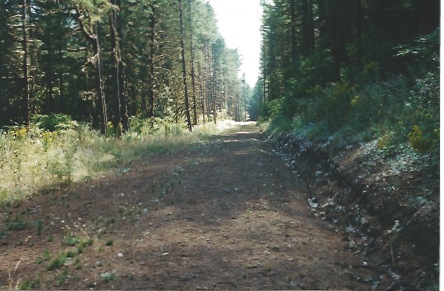
The soil type of this road is a heavy clay, A-7-6 –type material, which was treated with 0.022 litres/m2 of CBR Plus/Gravelock. Due to the change in the harvest schedule, the road was not used, therefore there was no further compaction by traffic following the initial construction.

Note: Growth of the grass was significantly better in the section treated with CBR Plus/Gravelock.

Due to no further compaction, when the treated layer finally released all of its moisture, the layer densified and caused shrinkage cracks. To remedy this, the grass was bladed off the surface and the layer re-compacted with a compactor and water tanker. No further treatment was required.


Untreated Road (little or no grass).


Untreated Road (minor shrinkage cracks).


Transition Partially Treated (not much grass).


Treated Road (grass after one season, self seeded).


Treated Road (grass growing abundantly over treated area).


Treated Road (note heavy clay soil in ditch while road is dry).


By: Rhino Rohrs

Rhide Technologies Inc.

www.cbrplus.com / www.gravelock.com

Wednesday, 4 July 2012

Stabilization of a Military Airstrip in Afghanistan


A military base in Central Afghanistan was experiencing problems with their landing strip, which was unpaved and causing severe dust problems during landing and takeoff.  The runway base consists of the local clayey soil and during the rainy season the surface ruts and also becomes very slippery.  The runway is used mainly for Hercules C130 supply aircraft and these conditions make landing on the runway difficult and dangerous.  Flights would have to be suspended at times, due to the poor condition of the runway.


The Military decided to try to remedy this problem by stabilizing the runway. 

To achieve this, the main consideration were:


  • The military base is in a remote location with hostile surroundings.
  • There is no local gravel that could be used to surface the runway.
  • If lime or cement stabilization of the base were to be a consideration, this material would have to be shipped in with truck convoys though Pakistan, and which would probably never reach the base’s location due to hostile action along the way.
  • The time constraints to get this project completed before the rainy season set in also prevented the lime or cement option, as well as the other option of setting up a crusher and grading sieves for local gravel production. 

The runway surface has stabilized now to such an extent, that the C130 planes leave rubber tire marks on the runway surface where the aircraft wheels touch down and make contact with the runway.


These factors led to the consideration of using a liquid soil stabilizer like CBR PLUS which is a highly concentrated liquid treatment medium and as result could be flown into the location on one flight together with the personnel to complete the operation.

Although the initial proposed treatment method was to scarify the surface or to haul in a suitable layer of soil and to then apply the stabilizer, it soon became apparent that these options would not be suitable, as there were numerous daily flights in and out on the runway.  This method of construction of the runway was therefore not possible.

The ability to spray apply the CBR PLUS / water mixture straight onto the surface in low dosages and repeated applications proved in the end to be the best solution.  This process was completed without having to delay or interrupt flights and the desired results were achieved. 

Shortly after completion rains set in for three days non-stop, with the runway hardening and being solid enough for the planes to continue using the airstrip. The runway was then also compacted with a vibrating roller compactor, to leave hard dry surface.


Dust has been reduced significantly as well. 


Before:
 After:
 After:

By: Rhino Rohrs

www.cbrplus.com / www.gravelock.com

Tuesday, 5 June 2012

Non-Standard Soil Stabilizers

There is the “myth” out there, that there are some wonder substances that will cure all soil stabilization and dust problems on all soil types in roads. This is unfortunately postulated as such, by some suppliers and users alike.  As a supplier of a particular material used to stabilize clays in road bases for some 15 years now, it has become very clear that, with the immense variety of soil types and road characteristics, that this type of silver bullet treatment is impossible.  The various products are usually suitable for a particular soil type or road design and not suitable to treat highly plastic clays and gravels with the same good results.  In many cases the products are applied to the wrong soil type and/or not constructed in the right way.  


We believe that there some good non-traditional road treatment products out there that are suitable for specific soil types and careful selection and design procedures for each project should be carried out before deciding on a specific product type.  In some cases there are similar technologies that will resolve a particular soil problem with differing results such as life cycle of the particular technology and the exercise then becomes more of a value engineering process.


By: Rhino Rohrs
Rhide Technologies Inc.


www.cbrplus.com / www.gravelock.com

Tuesday, 13 December 2011

Stabilization of Clay Road Bases.


Gravel preservation on unpaved rural roads has become the prime concerns for road maintenance by the Saskatchewan Regional Municipalities. This concern was highlighted in the recent study of the Department of Highways and Transportation on graveled roads in Saskatchewan and is heightened by the new practice whereby heavy axle load traffic gets diverted off the paved highways onto the gravel paved roads.

While current practice of Counties is to treat the surface on gravel surfaced roads with the application of dust palliatives such as calcium or magnesium chlorides, lignin sulfonates and asphalt emulsions in an effort to reduce gravel loss and dust, these mediums have been proven to be a temporary measure, which at best last one season or less. Gravel loss is mitigated and surface gravel is retained somewhat until these materials become leached out or otherwise ineffective. In areas with clay in the road base, this surface treatment is much less effective and gravel loss is exacerbated by the effects that the clay exhibits on the road and, particularly in wet weather, the gravel is pounded into the road base. Also due to the effects of poor base strength rutting and other deformation occurs in the wheel paths. Loose gravel is ground up onto fine powder and increases the dust on the roads.

Gravelock Technology addresses this problem and reduces gravel consumption on gravel surfaced roads by locking gravel into the road surface and so reducing gravel loss as well as reducing the need for gravel during initial construction by strengthening local soils. Gravelock improves road trafficability in wet weather and also helps to reduce dust in dry weather.

Gravelock is designed to increase the osmotic and matric suction of typical clay based soils, while reducing the moisture susceptibility. It is this behavior that increases the strength and stiffness of typical clay based soils, while also locking in the gravel to minimize gravel loss. This treatment is long term and reduces both maintenance and dust by up to 80%. Roads can be repaired after treatment without having to re-apply more Gravelock. Payback for many clients in Canada is less than 18 months.

We are now able to test your soils and ensure the best performance of your soil. On site supervision during construction ensures that the correct application and construction procedures are followed. Construction can be integrated with the road owner crews and equipment to help reduce outsourced costs or alternatively, full construction of a road can be provided with our equipment and crews.

By: Rhino Rohrs. 
Rhide Technologies Inc.
Email: rohrs@cbrplus.com

Wednesday, 7 December 2011

Road rehabilitation by COLD IN-PLACE RECYCLING of asphalt roads on clay.

Cold in place recycling or Full Depth Rehabilitation, is the most cost effective method available today for the rehabilitation of existing paved roads.

The top layer of asphalt or seal is milled with a Road Re-claimer or road milling machine to various depths (usually 15 to 30 cm.) depending on the thickness of the asphalt layer, so that the existing asphalt is broken down into small pieces. This milled asphalt is then mixed with the base material during this milling process.

Gravel (course grained materials) bases or sub bases are then stabilized by the injection of hot foamed asphalt during the milling process to compact and bind the gravel particles. This treatment binds the gravel particles together during their placement and also reduces the future effects of moisture in the treated layer.

This foamed asphalt process however cannot be used where the base contains fine-grained or clay soil with a plastic index higher than 6.


CLAYS, or fine-grained soils, can likewise be treated by injecting a CBR PLUS / Water mixture instead of the foamed asphalt into the milled layer during milling.

The effects of the CBR PLUS is to release the adsorbed or bound water from the clay particles and facilitate better compaction for higher resulting densities, while at the same time stabilizing the clay to reduce the effects that moisture will have on the treated layer.

It is no longer necessary to remove and replace the clay in the base with gravel or similar fine-grained material, since the treatment with CBR PLUS will strengthen the in situ clay material.

The milled asphalt layer is finely ground into a gravel-like material. During this milling process, the ground asphalt is mixed evenly into the base layer to mechanically strengthen the base material. At the same time the CBR PLUS/water mixture is sprayed into this finely ground soil/asphalt mixture to stabilize the clay. The milled asphalt, together with the effectively stabilized clay components in the modified soil mixture, provides a strong base layer that resists the effects of moisture.

COST SAVINGS
  • Obviates the need to haul away existing old asphalt/base soil - Work is done in place. 
  • New gravel to replace the existing clay base is no longer required. 
  • Provides a simpler and more cost effective stabilization than lime or cement. 
  • Requires only one pass with the Road Re-claimer - The work is fast. 
  • Treated layer is resistant to the effects of moisture - Lasts longer. 

By: Rhino Rohrs. 
Rhide Technologies Inc.
Email: rohrs@cbrplus.com